
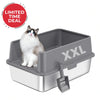
How to Choose the Right Cat Litter Box: A Complete Buyer's Guide
, by Gilded Grace Editorial, 5 min reading time
, by Gilded Grace Editorial, 5 min reading time
Most litter box problems aren't the cat — they're the box. Here's how to choose the right size, material, and configuration for your cat, your home, and the realities of multi-cat households.
If your cat is peeing outside the box, refusing to use it, or simply making a mess, the cat is rarely the problem. The box is. The pet industry has trained owners to accept tiny, plastic, awkwardly-shaped boxes that no self-respecting cat enjoys. Here is everything you actually need to know to pick the right litter box and avoid the mistakes that drive cats elsewhere.
Solve these and 80% of litter box problems disappear.
The rule: the box should be at least 1.5 times the length of your cat from nose to tail base. For most adult cats (10–12 pounds), that's an 18–22 inch box. Larger cats (Maine Coons, Ragdolls) need 24+ inches.
Don't trust the package label that says "Large" or "XL." Measure with a tape measure. Most retail "large" boxes are too small for adult cats.
If your cat squats high or pees standing up (yes, some do), you need high sides. Period.
Pros: Cheap, light, widely available.
Cons: Absorbs urine smell over time (yes, even non-porous plastic). Stains. Scratches from claws create bacteria-harboring crevices.
Replace: Every 1–2 years.
Pros: Doesn't absorb odors ever. Doesn't scratch. Easier to deep-clean. Lasts decades.
Cons: Higher upfront cost.
Replace: Never.
Rare and heavy, but the same anti-absorbent benefit as stainless. Look great in modern homes.
For a single cat over their lifetime, stainless steel costs less than 4–5 plastic replacements. It's also dramatically better for odor control.
Pros: Cat can see escape routes (essential for anxious cats), easier to scoop, better airflow, smaller spatial footprint.
Cons: Litter scatter, less privacy, smells dispersed.
Pros: Privacy, contained mess, contained smell.
Cons: Many cats hate them — trapped sensation, ammonia builds up inside (worse for the cat's lungs), bigger footprint.
The honest answer: most cats prefer open. If you're using a covered box and your cat goes outside, try open. If your cat is fine with covered, great.
Pros: Contains litter scatter beautifully, dogs can't access (great for households with dogs that eat from the litter box), looks discreet.
Cons: Older cats and kittens can't jump in. Some cats refuse them entirely. Hard to deep-clean.
Best as a secondary box, not your only one.
Brands like Litter-Robot, PetSafe, and others offer automated scoopers. Worth it for:
Not worth it if:
The veterinarian rule: one box per cat, plus one extra.
And spread them across the home — not next to each other. Two boxes in the same bathroom counts as one box to a cat.
Pair the right box with the right litter. Most cats prefer:
Browse our pet supplies collection for high-sided stainless steel litter boxes, scoops, and the essentials that solve the most common cat issues.